Vigyázok Rád
Otthonoknak
Amit egy 15–25 szobás idősotthonnak építünk — és amit szándékosan nem.
TERV. Ez a lap egy készülő rendszert ír le, nem egy megvásárolható terméket. Azért olvasható nyilvánosan, mert két otthon kérdezett rá, és mert jobb, ha időben vitatkozik vele valaki, mint ha később derül ki, hogy rosszul gondoltuk. Hogy pontosan mi működik ma, azt a Hol tartunk ma pont mondja meg.
Mindenek előtt
Ez nem nővérhívó rendszer
Fontos — kérjük, ezt olvassák el először
Egy idősotthonnak rendes, tanúsított nővérhívó rendszerre van szüksége.
Ezt még az előtt mondjuk el, hogy bármit leírnánk arról, amit mi építünk, mert minden további ezt feltételezi. A mi rendszerünk egy nővérhívó rendszer MELLÉ készül, nem helyette. Nem lehet az egyetlen módja a segítségkérésnek, és nem is szeretnénk, hogy az legyen.
Tanúsított rendszerek készen kaphatók bejáratott szállítóktól. Szívesen segítünk összehasonlítani őket, és abban is, hogy a miénk szépen illeszkedjen ahhoz, amit választanak — de mi nem építünk ilyet, és nem állítjuk, hogy amit építünk, az az.
Azért ez áll elöl, mert ez a lap legértékesebb mondata, és mert könnyű — és helytelen — volna kihagyni. Innentől minden arról szól, amit egy tanúsított nővérhívó nem csinál.
Kiknek készül
A kisebb házaknak
Ez a csomag 15–25 szobás, magánkezelésben lévő otthonoknak készül. Nem véletlenül.
A nagy, intézményi rendszerek léteznek, jók, és drágák. Egy néhány tucat szobás háznak viszont rendszerint olyasmit adnak el, amire nincs szüksége — olyan áron, amit nem bír el. Így aztán a kisebb otthonok gyakran maradnak annál, ami majdnem semmi: egy csengő, egy zsinór, egy walkie-talkie.
Néhány héten belül két ilyen ház kérdezett rá. Az egyikben demenciával élő embereket gondoznak; a másikban olyan időseket, akik szellemileg frissek, de magukat már nem tudják ellátni. Két majdnem ellentétes feladat, ugyanazzal a hardverrel — erről szól a „Nem minden otthon egyforma" pont.
Amiért ez több, mint egy ötlet
Az egyik otthon felajánlotta, hogy tanácsokkal és tapasztalattal segíti a fejlesztést. Ez többet ér minden specifikációnál, amit mi magunktól kitalálnánk: ők tudják, mi történik hajnali háromkor egy folyosón, mi nem.
Amit építeni szeretnénk
Négy darab, egy rendszer
| Hol | Mi |
|---|---|
| Minden szobában | Fali konzol egyetlen nagy segítség-gombbal. Igény szerint hordozható vagy távirányítós gomb, ami egy idős embernek gyakran könnyebb, mint egy falra szerelt panel. |
| Minden szobában | Gyógyszer-visszaigazoló gomb, és mögötte a napló. |
| A nővérpultnál | Nagy képernyőn futó program, amely egyszerre mutatja az összes szobát, hanggal. Akár több pultnál is. |
| Valahol az épületben | Egyetlen kis számítógép, amely a naplót őrzi. Az épületből semmi nem megy ki. |
Egy tervezési döntés, amit érdemes tudni
Ha több nővérpult van, egyik állomás sem lehet a főnök. A napló egy helyen él — a kis számítógépen —, és minden állomás csak ablak rá. Különben a képernyők lassan eltérnek egymástól, és senki nem tudja megmondani, melyiknek van igaza.
A gyógyszer-napló
Itt a leghasznosabb — és itt lehetne a legkönnyebben elrontani
Minden beadás négy dolgot rögzít: melyik lakó, melyik kör (például a 08:00-s), melyik dolgozó igazolta vissza, és pontosan mikor nyomták meg a gombot.
A szóhasználat többet számít, mint amennyinek látszik
Fontos — mit állít és mit nem állít a rendszer
A rendszer soha nem írja ki, hogy „a gyógyszer be lett adva", mert ezt nem tudja. Azt tudja, hogy valaki megnyomott egy gombot.
Ezért a képernyőn ez áll: „08:12 — visszaigazolta: …", vagy „nincs visszaigazolás". Az első a saját naplónkról szóló állítás, és mindig igaz. A másik fajta megfogalmazás — állítás arról, hogy mi történt valójában a szobában — az, amelyik kárt okoz, ha tévesnek bizonyul.
A naplóhoz hozzáírunk, soha nem írjuk át
A gyógyszer-napló csak bővíthető: a bejegyzéseket soha nem szerkesztjük és nem töröljük. Ha valamit tévesen rögzítettek, a javítás új bejegyzésként kerül be, és mindkettő látható marad a saját időpontjával. A klinikai nyilvántartások így működnek, és éppen ez teszi egyáltalán érdemessé a naplót a vezetésre.
Hogyan azonosítja magát a dolgozó
A javaslatunk a koppintós kulcstartó — ugyanolyan, amilyet az ajtókhoz amúgy is hordanak. Két másodperc, nincs elfelejthető vagy továbbadható jelszó, és kesztyűben is működik.
Megjegyzés — őszintén arról, mit bizonyít egy kulcstartó
Egy kulcstartót kölcsön lehet adni vagy ott lehet felejteni az asztalon. Ezért a napló helyesen azt mondja: „a 7-es kulcstartót koppintották", nem azt, hogy „X nővér ott volt". A gyakorlatban ez elég, és összehasonlíthatatlanul jobb, mint egy olvashatatlan szignó a papíron — de a saját szabályzatukban pontosan így érdemes leírni.
Két gyakorlati dolog
- Az óra. Egy időbélyeg semmit nem ér, ha rossz az óra. A rendszer magától szinkronban tartja az idejét, és a napló mutatja, mikor ellenőrizte utoljára.
- Ha nincs hálózat. A konzol helyben rögzít, és elküldi, amint a hálózat visszajön — a bejegyzés pedig jelölve lesz, hogy később érkezett, hogy senkinek ne kelljen találgatnia.
Ez a dolgozókért van, nem ellenük
A személyzet gyakran úgy várja az ilyen rendszert, hogy a lebuktatásukra készül. A gyakorlatban ennek az ellenkezője igaz: ha hetekkel később kérdés merül fel, épp az időbélyeges napló mutatja meg, hogy a kör megtörtént. A papír sokkal gyakrabban hagyja cserben a nővért, mint a vezetőt.
Amit NEM csinál
Inkább most legyünk világosak
- Nem nővérhívó rendszer, és nem is szabad annak használni.
- Nem orvostechnikai eszköz. Nem adagol, nem mér, nem diagnosztizál és nem dönt el semmit.
- Nem helyettesíti a gyógyszerkört és nem helyettesíti a nővér ítéletét. Napló és emlékeztető.
- Nem figyeli a lakókat. Nincs kamera és nincs mikrofon.
- Nem életvédelmi rendszer, és ezt senkinek nem szabad másként mondani.
A szabály, ami szerint építjük
A csend nem jelent biztonságot
Fontos — amire támaszkodhatnak, annak bizonyítania kell, hogy él
Egy tanúsított nővérhívó figyeli a saját vezetékeit: ha elvágják, riaszt. A miénk ennek a szoftveres megfelelőjét teszi — minden konzol folyamatosan jelentkezik, és ha egy elhallgat, a nővérpult ezt kimondja: szavakkal és hangosan.
A csend soha nem látszhat úgy, mintha minden rendben volna. Ez az egész terv legfontosabb szabálya, és ez az oka annak, hogy a rendszert egyáltalán fel merjük ajánlani.
Ehhez tartozik egy állandó szabályunk minden munkánkban: a szín soha nem az egyetlen jelzés. Ami fontos, az szövegként és alakként is megjelenik, hogy a színtévesztőnek is olvasható legyen, és annak is, aki a folyosó túlsó végéről néz oda. Ez a lap is így készült.
Nem minden otthon egyforma
Két ház, két majdnem ellentétes feladat
Ez az a rész, ahol nekünk sokkal nagyobb szükségünk van az otthonok tudására, mint nekik a miénkre. Az alábbiakat kérjük kiinduló feltevésnek tekinteni, nem specifikációnak.
A legfontosabb, amit úgy hisszük, értünk
Egy demenciával élő ember gyakran nem tud segítséget kérni — nem azért, mert nem éri el a gombot, hanem mert nem jut eszébe, hogy van. Ezért az értékes jel sokszor épp valaminek a hiánya: nincs visszaigazolás, nincs mozgás, hajnali háromkor kinyílik egy ajtó.
Ettől lesz ez más termék, mint a „nyomd meg a gombot és jön a nővér" — és ezért érdekel minket a feladat.
Ahol demenciával élnek
- A szobai képernyő a lehető legkevesebbet mutassa. Egy gomb. Semmi változó szöveg, semmi állapot-ikon, semmi verziószám — a változó képernyő zavart okoz. Minden diagnosztika a nővérpultra való.
- Az éjszaka más. A képernyő nem világíthatja be a hálószobát. Alapból teljesen sötét lenne éjjel, miközben a gomb továbbra is működik.
- A konzolt elérni lehessen, letépni ne. A szerelési magasságot és a rögzítést a helyszínen, közösen érdemes eldönteni.
Ahol a lakók szellemileg frissek
- Ők többet akarnak, nem kevesebbet. Ugyanaz a konzol tud nekik üzenetet, időpontot és emlékeztetőt mutatni, és van rajta egy „Jól vagyok" csempe is.
- A magánélet itt súlyosabb kérdés. Aki tisztán gondolkodik, annak joga van tudni, mit rögzít a rendszer róla — és joga van nemet mondani rá.
- Ugyanaz a hardver, másik beállítás. Ez a terv szíve: nem két termék, hanem egy, amit a ház állít be magának.
A nővérpult képernyője
Segítség Központ — most kezdtük el
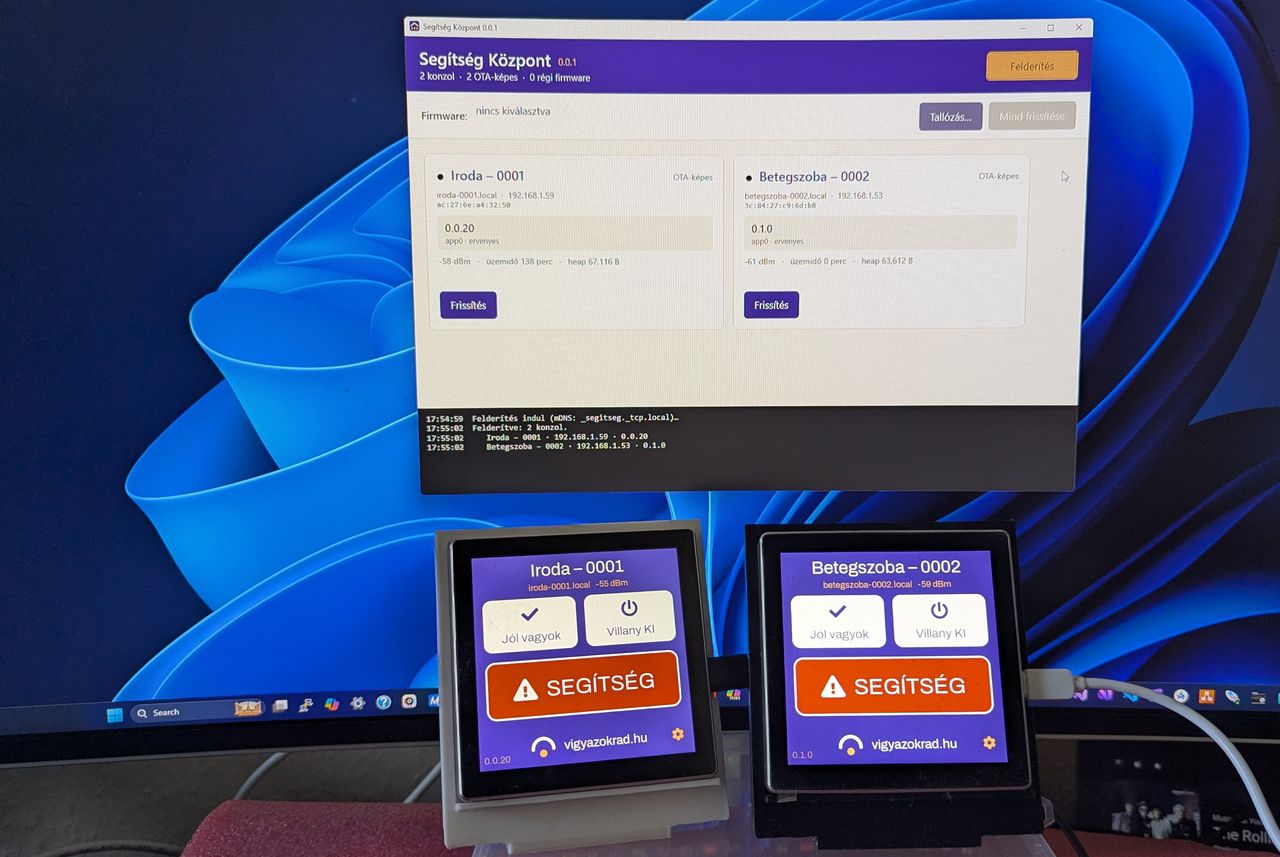
A rendszer másik fele az a képernyő, ami a pulton áll. Ma ennyi van belőle: egy program, amely magától megtalálja a ház konzoljait a hálózaton, mindegyikről megmutatja, hogy él-e, milyen erős a jele és melyik változat fut rajta — és egy gombnyomással frissíteni tudja őket, kábel nélkül.
Megjegyzés — a verziószám szándékosan van kiírva
A képen 0.0.1 áll. Ez az első működő darab, nem a kész képernyő. Nagyságrendekkel többet fog tudni ennél: minden szoba egy csempén, riasztás hanggal, a gyógyszerkör állapota, és a néma konzol kimondva. Azért mutatjuk meg mégis így, mert ez van, és mert a félkész dolgot félkészként megmutatni tisztességesebb, mint egy látványtervet mutatni késznek.
És ami ezen túl van
Ugyanennek a nézetnek van egy sokkal nagyobb változata is, amely nem egy házat, hanem sok házat követ egyszerre, akár országos szinten. Az ilyen rendszerek léteznek. De a tapasztalatunk eddig inkább azt mondja, hogy a valódi hiány nem ott van: a 15–25 szobás házaknak ma nincs kihez fordulniuk. Ezért kezdjük a helyi csomaggal.
Hol tartunk ma
Becsületesen arról, mi kész és mi nincs
Ami ma él, és le van mérve
- A fali konzol: nagy SEGÍTSÉG gomb, két csempe, saját hálózati név.
- A konzolok szólnak egymásnak: a hívás megjelenik a másik szobában, és a „Jövök!" válasz visszaér a hívóhoz. Két igazi panellal mérve: tíz másodperc.
- Frissítés a hálózaton keresztül, kábel nélkül — és ha egy frissítés rosszul sülne el, az eszköz magától visszaáll az előző, működő változatra.
- A Segítség Központ 0.0.1: felderítés és frissítés.
Ami még nincs meg
- A gyógyszer-napló és a kulcstartós azonosítás.
- A nővérpult teljes képernyője és a hangjelzés.
- A kis számítógép, ami a naplót őrzi.
- Bármilyen telepítés éles otthonban. Ez még nem történt meg.
Fontos — miért egyetlen szoba lesz az első
Amikor eljön az első telepítés, az egyetlen szobával kezdődik, nem tizenöttel. Egy szoba, néhány hét, és utána kérdések — mielőtt bárhol máshol furnánk a falba. Aki ennél gyorsabbat ígér, az nem az otthon érdekét nézi.
Vigyük magunkkal
Rövid ismertető, két oldalon
Ugyanez a terv egy lapra fogva, kinyomtatható formában — ha valakinek papíron kell megmutatni, vagy egy megbeszélésre elvinni.
Ismertető letöltése — PDF, 240 kB, 2 oldalHa van véleménye róla
Ezt a lapot azért tettük ki, hogy vitatkozzanak vele. Ha egy otthont vezet, ott dolgozik, vagy hozzátartozóként ismeri belülről: minden ellenvetés hasznosabb most, mint később.
Írjon nekünk: info@vigyazokrad.hu
Für Pflegeheime
Was wir für ein Haus mit 15–25 Zimmern bauen — und was bewusst nicht.
ENTWURF. Diese Seite beschreibt ein System im Aufbau, kein Produkt, das man kaufen kann. Sie ist öffentlich, weil zwei Häuser danach gefragt haben — und weil Widerspruch heute mehr wert ist als eine späte Erkenntnis. Was heute tatsächlich läuft, steht unter Wo wir heute stehen.
Zuallererst
Das ist keine Schwesternrufanlage
Wichtig — bitte zuerst lesen
Ein Pflegeheim benötigt eine ordentliche, zertifizierte Schwesternrufanlage.
Wir sagen das, bevor wir irgendetwas über unser eigenes System schreiben, denn alles Weitere setzt es voraus. Unser System ist dafür gebaut, NEBEN einer Schwesternrufanlage zu arbeiten, nicht an ihrer Stelle. Es darf nicht der einzige Weg sein, Hilfe zu rufen, und wir möchten auch nicht, dass es das wird.
Zertifizierte Anlagen sind bei etablierten Anbietern fertig erhältlich. Wir helfen gern beim Vergleich und sorgen dafür, dass unser System sauber daneben passt — aber wir bauen keine solche Anlage, und wir behaupten nicht, dass unsere eine wäre.
Das steht deshalb ganz vorn, weil es der wertvollste Satz dieser Seite ist und weil es leicht — und falsch — wäre, ihn wegzulassen. Alles Weitere handelt davon, was eine zertifizierte Schwesternrufanlage nicht leistet.
Für wen
Für die kleineren Häuser
Dieses Paket ist für privat geführte Häuser mit 15–25 Zimmern gedacht. Das hat einen Grund.
Die großen, institutionellen Systeme gibt es, sie sind gut, und sie sind teuer. Einem Haus mit ein paar Dutzend Zimmern verkauft man dabei meist etwas, das es nicht braucht — zu einem Preis, den es nicht trägt. Und so bleiben kleinere Heime oft bei dem, was fast nichts ist: eine Klingel, eine Zugschnur, ein Funkgerät.
Innerhalb weniger Wochen haben zwei solche Häuser nachgefragt. In dem einen werden Menschen mit Demenz betreut; im anderen ältere Menschen, die geistig klar sind, sich aber nicht mehr selbst versorgen können. Zwei fast gegensätzliche Aufgaben, mit derselben Hardware — davon handelt der Abschnitt „Kein Haus ist wie das andere".
Warum das mehr ist als eine Idee
Eines der Häuser hat angeboten, die Entwicklung mit Rat und Erfahrung zu begleiten. Das ist mehr wert als jede Spezifikation, die wir uns selbst ausdenken könnten: Sie wissen, was um drei Uhr nachts auf einem Flur geschieht. Wir nicht.
Was wir bauen möchten
Vier Teile, ein System
| Wo | Was |
|---|---|
| In jedem Zimmer | Eine Wandkonsole mit einer großen Hilfetaste. Auf Wunsch zusätzlich eine tragbare Taste oder ein Funktaster — für ältere Menschen oft leichter als ein Panel an der Wand. |
| In jedem Zimmer | Eine Bestätigungstaste für Medikamente und die Dokumentation dahinter. |
| Am Schwesternplatz | Ein Programm auf einem großen Bildschirm, das alle Zimmer gleichzeitig zeigt, mit Ton. Auch an mehreren Plätzen. |
| Irgendwo im Haus | Ein kleiner Rechner, der die Dokumentation speichert. Nichts verlässt das Gebäude. |
Eine Entwurfsentscheidung, die Sie kennen sollten
Bei mehreren Schwesternplätzen darf keine der Stationen die führende sein. Die Dokumentation liegt an einer Stelle — auf dem kleinen Rechner —, und jede Station ist nur ein Fenster darauf. Sonst laufen die Bildschirme langsam auseinander, und niemand kann sagen, welcher recht hat.
Die Medikamenten-Dokumentation
Hier ist das System am nützlichsten — und hier ließe es sich am leichtesten falsch machen
Jede Gabe erfasst vier Dinge: welche Bewohnerin oder welcher Bewohner, welcher Durchgang (zum Beispiel der um 08:00 Uhr), welche Mitarbeiterin oder welcher Mitarbeiter bestätigt hat und der genaue Zeitpunkt des Tastendrucks.
Die Wortwahl zählt mehr, als es aussieht
Wichtig — was das System behauptet und was nicht
Das System zeigt niemals „Medikament eingenommen" an, denn das weiß es nicht. Es weiß, dass jemand eine Taste gedrückt hat.
Deshalb steht auf dem Bildschirm: „08:12 — bestätigt von …" oder „nicht bestätigt". Das Erste ist eine Aussage über unsere eigene Dokumentation und ist immer wahr. Die andere Art der Formulierung — eine Behauptung darüber, was im Zimmer tatsächlich geschehen ist — richtet Schaden an, wenn sie sich als falsch erweist.
Es wird ergänzt, nie geändert
Die Medikamenten-Dokumentation ist nur erweiterbar: Einträge werden nie bearbeitet und nie gelöscht. Wurde etwas falsch erfasst, wird die Korrektur als neuer Eintrag hinzugefügt, und beide bleiben mit ihren Zeiten sichtbar. So arbeiten klinische Aufzeichnungen, und genau das macht eine Dokumentation überhaupt erst wertvoll.
Wie sich Mitarbeitende ausweisen
Wir empfehlen einen Transponder zum Auflegen — dieselbe Art Schlüsselanhänger, den Ihre Mitarbeitenden ohnehin für Türen tragen. Zwei Sekunden, kein Passwort zum Vergessen oder Weitergeben, und er funktioniert auch mit Handschuhen.
Hinweis — was ein Transponder ehrlicherweise beweist
Ein Transponder kann verliehen oder auf dem Tisch liegen gelassen werden. Deshalb sagt die Dokumentation korrekt: „Transponder 7 wurde aufgelegt", nicht „Schwester X war anwesend". In der Praxis genügt das und ist weit besser als ein unleserliches Kürzel auf Papier — in Ihren eigenen Verfahrensanweisungen sollte es aber genau so beschrieben werden.
Zwei praktische Punkte
- Die Uhr. Ein Zeitstempel ist wertlos, wenn die Uhr falsch geht. Das System hält seine Zeit automatisch synchron, und die Dokumentation zeigt, wann die Zeit zuletzt geprüft wurde.
- Wenn das Netz ausfällt. Die Konsole erfasst lokal und sendet nach, sobald das Netz zurück ist — der Eintrag wird als verspätet eingegangen gekennzeichnet, damit niemand raten muss.
Das ist für Ihre Mitarbeitenden, nicht gegen sie
Personal erwartet von solchen Systemen oft, dass sie dem Ertappen dienen. In der Praxis ist das Gegenteil der Fall: Wenn Wochen später Fragen aufkommen, ist es gerade die Dokumentation mit Zeitstempel, die zeigt, dass der Durchgang stattgefunden hat. Papier lässt Pflegekräfte weit häufiger im Stich als die Leitung.
Was es NICHT tut
Lieber jetzt deutlich als später missverstanden
- Es ist keine Schwesternrufanlage und darf auch nicht als solche verwendet werden.
- Es ist kein Medizinprodukt. Es dosiert nicht, misst nicht, diagnostiziert nicht und entscheidet nichts.
- Es ersetzt weder den Medikamentendurchgang noch das Urteil einer Pflegekraft. Es ist Dokumentation und Erinnerung.
- Es beobachtet keine Bewohner. Es gibt keine Kameras und keine Mikrofone.
- Es ist kein System der Lebenssicherheit, und niemandem darf etwas anderes gesagt werden.
Die Regel, nach der wir bauen
Stille bedeutet nicht Sicherheit
Wichtig — worauf man sich verlassen könnte, muss beweisen, dass es lebt
Eine zertifizierte Schwesternrufanlage überwacht ihre eigene Verkabelung: Wird ein Kabel durchtrennt, schlägt sie Alarm. Unsere leistet das Gleiche in Software — jede Konsole meldet sich fortlaufend, und wenn eine verstummt, sagt es der Schwesternplatz deutlich, in Worten und hörbar.
Stille darf niemals so aussehen wie „alles in Ordnung". Das ist die wichtigste Regel des gesamten Entwurfs, und sie ist der Grund, warum wir das System überhaupt anbieten können.
Dazu gehört eine feste Regel in allem, was wir bauen: Farbe ist niemals das einzige Signal. Alles Wichtige erscheint auch als Text und als Form, damit es für farbenblinde Menschen lesbar bleibt — und für jemanden, der vom anderen Ende des Flurs hinsieht. Auch diese Seite ist so gebaut.
Kein Haus ist wie das andere
Zwei Häuser, zwei fast gegensätzliche Aufgaben
Das ist der Teil, in dem wir das Wissen der Häuser weit dringender brauchen als sie unseres. Bitte betrachten Sie das Folgende als Ausgangsannahmen, nicht als Spezifikation.
Das Wichtigste, das wir zu verstehen glauben
Ein Mensch mit Demenz kann oft nicht um Hilfe rufen — nicht weil die Taste unerreichbar wäre, sondern weil ihm nicht einfällt, dass es sie gibt. Deshalb ist das wertvolle Signal häufig das Ausbleiben von etwas: keine Bestätigung, keine Bewegung, eine Tür, die um drei Uhr nachts aufgeht.
Das macht daraus ein anderes Produkt als „Taste drücken, Pflegekraft kommt" — und deshalb interessiert uns die Aufgabe.
Wo Menschen mit Demenz leben
- Der Bildschirm im Zimmer zeigt so wenig wie möglich. Eine Taste. Kein wechselnder Text, keine Statussymbole, keine Versionsnummern — ein wechselnder Bildschirm verunsichert. Alles Diagnostische gehört an den Schwesternplatz.
- Die Nacht ist anders. Ein Bildschirm darf ein Schlafzimmer nicht erhellen. Voreinstellung: nachts vollständig dunkel, die Taste bleibt aktiv.
- Die Konsole muss erreichbar, aber nicht abreißbar sein. Montagehöhe und Befestigung entscheiden wir am besten gemeinsam vor Ort.
Wo die Bewohner geistig klar sind
- Sie wollen mehr, nicht weniger. Dieselbe Konsole kann ihnen Nachrichten, Termine und Erinnerungen zeigen, und sie hat eine Kachel „Mir geht es gut".
- Privatsphäre wiegt hier schwerer. Wer klar denkt, hat ein Recht darauf zu wissen, was das System über ihn festhält — und ein Recht, Nein zu sagen.
- Dieselbe Hardware, andere Einstellung. Das ist der Kern des Entwurfs: nicht zwei Produkte, sondern eines, das sich das Haus selbst einstellt.
Der Bildschirm am Schwesternplatz
Segítség Központ — gerade erst begonnen
Die andere Hälfte des Systems ist der Bildschirm am Schwesternplatz. Heute gibt es davon so viel: ein Programm, das die Konsolen des Hauses im Netzwerk von selbst findet, zu jeder anzeigt, ob sie lebt, wie stark ihr Funksignal ist und welche Version auf ihr läuft — und sie auf Tastendruck aktualisiert, ohne Kabel.
Hinweis — die Versionsnummer steht absichtlich da
Auf dem Bild steht 0.0.1. Das ist das erste lauffähige Stück, nicht der fertige Bildschirm. Er wird um Größenordnungen mehr können: jedes Zimmer als Kachel, Alarm mit Ton, der Stand des Medikamentendurchgangs, und die verstummte Konsole ausgesprochen. Wir zeigen es trotzdem so, weil es das ist, was existiert — und weil Halbfertiges als halbfertig zu zeigen redlicher ist, als eine Designstudie für fertig auszugeben.
Und was darüber hinausgeht
Von derselben Ansicht gibt es auch eine weit größere Variante, die nicht ein Haus, sondern viele Häuser gleichzeitig verfolgt, bis hin zur landesweiten Ebene. Solche Systeme existieren. Unsere bisherige Erfahrung sagt aber eher, dass die eigentliche Lücke woanders liegt: Häuser mit 15–25 Zimmern haben heute niemanden, an den sie sich wenden können. Deshalb beginnen wir mit dem lokalen Paket.
Wo wir heute stehen
Ehrlich dazu, was fertig ist und was nicht
Was heute läuft und gemessen ist
- Die Wandkonsole: große HILFE-Taste, zwei Kacheln, eigener Netzwerkname.
- Die Konsolen sprechen miteinander: Der Ruf erscheint im anderen Zimmer, und die Antwort „Ich komme!" kommt beim Rufenden an. Mit zwei echten Panels gemessen: zehn Sekunden.
- Aktualisierung über das Netzwerk, ohne Kabel — und sollte eine Aktualisierung schiefgehen, kehrt das Gerät von selbst zur vorigen, funktionierenden Version zurück.
- Das Segítség Központ in 0.0.1: Suchen und Aktualisieren.
Was noch fehlt
- Die Medikamenten-Dokumentation und der Transponder.
- Der vollständige Bildschirm am Schwesternplatz und der Ton.
- Der kleine Rechner, der die Dokumentation speichert.
- Jede Installation in einem echten Haus. Das ist noch nicht geschehen.
Wichtig — warum zuerst ein einziges Zimmer
Wenn die erste Installation kommt, beginnt sie mit einem einzigen Zimmer, nicht mit fünfzehn. Ein Zimmer, ein paar Wochen, danach Fragen — bevor irgendwo sonst in eine Wand gebohrt wird. Wer Schnelleres verspricht, denkt nicht an das Haus.
Zum Mitnehmen
Kurzfassung auf zwei Seiten
Derselbe Entwurf auf einem Blatt, zum Ausdrucken — falls jemand es auf Papier zeigen oder zu einer Besprechung mitnehmen möchte.
Kurzfassung herunterladen — PDF, 242 kB, 2 SeitenWenn Sie eine Meinung dazu haben
Diese Seite steht hier, damit ihr widersprochen wird. Wenn Sie ein Haus leiten, dort arbeiten oder es als Angehörige von innen kennen: jeder Einwand ist heute nützlicher als später.
Schreiben Sie uns: info@vigyazokrad.hu
For care homes
What we are building for a 15–25 room home — and what we deliberately are not.
A PLAN. This page describes a system being built, not a product you can buy. It is public because two homes asked about it — and because disagreement now is worth more than a late discovery. What actually runs today is set out under Where we are today.
Before anything else
This is not a nurse call system
Important — please read this first
A care home needs a proper, certified nurse call system.
We are saying this before we describe anything we build, because everything below assumes it. Our system is designed to sit alongside a nurse call system, not to replace one. It cannot be the only way of calling for help, and we would not want it to be.
Certified systems are available off the shelf from established suppliers. We are happy to help compare them and to make sure ours works neatly beside whichever is chosen — but we will not build one, and we will not pretend that what we build is one.
We say this first because it is the most valuable sentence on this page, and because it would be easy — and wrong — to leave it out. Everything after this point is about what a certified nurse call system doesn't do.
Who it is for
The smaller homes
This package is for privately run homes of 15–25 rooms. That is not an accident.
The large institutional systems exist, they are good, and they are expensive. What a home of a few dozen rooms usually gets offered is something it does not need, at a price it cannot carry. So smaller homes often stay with what is barely anything at all: a bell, a pull cord, a walkie-talkie.
Within a few weeks, two such homes asked about this. One cares for people living with dementia; the other for older people who are cognitively well but can no longer manage on their own. Two almost opposite problems, on the same hardware — that is what the section “No two homes are alike” is about.
Why this is more than an idea
One of the homes offered to help the development with advice and experience. That is worth more than any specification we could invent on our own: they know what happens in a corridor at three in the morning. We do not.
What we propose to build
Four parts, one system
| Where | What |
|---|---|
| Every room | A wall console with one large help button. Optionally a wearable or remote button, which is often easier for an older person than a panel on a wall. |
| Every room | A medication confirmation button, and the record behind it. |
| At the nurse station | A program on a large screen showing every room at once, with sound. At more than one station if needed. |
| Somewhere in the building | One small computer that holds the records. Nothing leaves the building. |
A design decision worth knowing about
With more than one nurse station, no station can be the master. The records live in one place — the small computer — and every station is a window onto it. Otherwise the screens slowly disagree with each other, and nobody can tell which one is right.
The medication record
Where the system is most useful — and most easily got wrong
Every administration records four things: which resident, which round (for example the 08:00 round), which member of staff confirmed it, and the exact time the button was pressed.
The wording matters more than it looks
Important — what the system will and will not claim
The system will never display “medication taken”, because it does not know that. It knows that somebody pressed a button.
So the screen says “confirmed at 08:12 by …”, or “not confirmed”. The first is a statement about our own record and is always true. The second kind of wording — a claim about what actually happened in the room — is the kind that causes harm when it turns out to be wrong.
Records are added to, never changed
A medication record is append-only: entries are never edited and never deleted. If something was recorded wrongly, a correction is added, and both entries remain visible with their times. This is how clinical records work, and it is the thing that makes a record worth having at all.
How staff identify themselves
Our recommendation is a tap fob — the same kind of token staff already carry for doors. It takes two seconds, there is no password to forget or to share, and it works with gloves on.
Note — being honest about what a fob proves
A fob can be lent or left on a desk. So the record properly says “fob 7 was tapped”, not “Nurse X was present”. In practice this is enough, and it is much better than an illegible initial on paper — but it should be described accurately in a home's own procedures.
Two practical matters
- The clock. A timestamp is worth nothing if the clock is wrong. The system keeps its time synchronised automatically, and the record shows when the time was last verified.
- If the network is down. The console records locally and sends it on when the network returns — and the record is marked as having arrived late, so nobody has to guess.
This is for staff, not against them
Staff often expect a system like this to be about catching people out. In practice the opposite is true: when something is questioned weeks later, a timed record is what shows the round was done. Paper charts fail nurses far more often than they fail managers.
What it does NOT do
Better clear now than misunderstood later
- It is not a nurse call system and must not be used as one.
- It is not a medical device. It does not dispense, measure, diagnose or decide anything.
- It does not replace the medication round or a nurse's judgement. It is a record and a reminder.
- It does not watch residents. There are no cameras and no microphones.
- It is not a life-safety system, and nobody should be told that it is.
The rule we build by
Silence does not mean safety
Important — a system people may rely on must prove it is alive
A certified nurse call system watches its own wiring: cut a cable and it raises an alarm. Ours does the equivalent in software — every console reports in continuously, and if one goes quiet the nurse station says so plainly, in words, and out loud.
Silence must never look like “everything is fine”. This is the single most important rule in the whole design, and it is the reason we can offer the system at all.
Related, and a standing rule in everything we build: colour is never the only signal. Anything important is shown as text and shape as well as colour, so it still reads correctly for someone who is colour-blind or looking at the screen from across a corridor. This page is built the same way.
No two homes are alike
Two homes, two almost opposite problems
This is the part where we need the homes' expertise far more than they need ours, so please treat what follows as our opening assumptions rather than a specification.
The most important thing we think we understand
A person living with dementia often cannot call for help — not because the button is out of reach, but because it does not occur to them that it exists. So the valuable signal is frequently the absence of something: no confirmation, no movement, a door opening at three in the morning.
That makes this a different product from “press the button and a nurse comes”, and it is why we are interested in the project.
Where people live with dementia
- The screen in the room shows as little as possible. One button. No changing text, no status icons, no version numbers — a screen that changes is a screen that causes distress. Everything diagnostic belongs at the nurse station.
- Night matters. A screen must not light a bedroom. We would default to fully dark at night with the button still working.
- The console must be reachable but not removable. Mounting height and fixing are things to decide together, on site.
Where residents are cognitively well
- They want more, not less. The same console can show them messages, appointments and reminders, and it carries an “I'm all right” tile.
- Privacy weighs heavier here. Someone who thinks clearly has a right to know what the system records about them — and a right to say no.
- Same hardware, different setting. This is the heart of the design: not two products, but one that the home configures for itself.
The screen at the nurse station
Segítség Központ — only just started
The other half of the system is the screen that sits on the desk. This is how much of it exists today: a program that finds the house's consoles on the network by itself, shows for each whether it is alive, how strong its signal is and which version it is running — and updates them at the press of a button, with no cable.
Note — the version number is shown on purpose
The picture says 0.0.1. This is the first working piece, not the finished screen. It will do orders of magnitude more: every room as a tile, alarms with sound, the state of the medication round, and the silent console said out loud. We show it like this anyway, because it is what exists — and because showing something half-built as half-built is more honest than presenting a mock-up as finished.
And what lies beyond it
There is a much larger version of this same view, one that follows not a single house but many at once, up to a national scale. Systems like that exist. But our experience so far says the real gap is somewhere else: homes of 15–25 rooms have nobody to turn to today. So we are starting with the local package.
Where we are today
Honestly about what is done and what is not
What runs today, and is measured
- The wall console: a large HELP button, two tiles, its own network name.
- The consoles speak to each other: the call appears in the other room, and the “I'm coming!” reply gets back to whoever called. Measured with two real panels: ten seconds.
- Updates over the network, with no cable — and if an update were to go wrong, the device returns by itself to the previous, working version.
- The Segítség Központ at 0.0.1: discovery and updating.
What is not there yet
- The medication record and fob identification.
- The full nurse station screen and the sound.
- The small computer that holds the records.
- Any installation in a real home. That has not happened yet.
Important — why one room will be first
When the first installation comes, it starts with a single room, not fifteen. One room, a few weeks, and then questions — before a hole is drilled anywhere else. Anyone promising faster is not thinking about the home.
To take away
A short version, two pages
The same plan on one sheet, in a printable form — for showing on paper, or taking to a meeting.
Download the summary — PDF, 237 kB, 2 pagesIf you have a view on this
This page is published so that people can argue with it. If you run a home, work in one, or know one from the inside as a relative: every objection is more useful now than later.
Write to us: info@vigyazokrad.hu